 AutoWeight
A public CartPole policy scored 164.60 out of a possible 500 in a reserved evaluation. After an edit to a small set of parameters, it scored 465.14. The network had not been retrained. GPT-6 Astra had proposed changing how strongly it responded to pole angle and how sharply it chose actions. The candidate passed all six of the experiment’s checks: improvement in return and near-completion, and preservation of 200-step survival, evaluated separately for left- and right-tilted starts. [1]
That is a promising result for an LLM acting as an optimizer. But it leaves two questions open. Could a simpler method do as well? And when an edit helps one behavior, what happens to the others?
Those questions became the thread connecting our AutoWeight experiments across vision, control, and language. The collection covers performance improvement, calibration, and regression repair: most policy cases start from a performance shortfall, rather than a documented loss between historical checkpoints. AutoWeight is the toolkit used to apply and evaluate the proposed changes. [10] Some edits worked for reasons we can explain mathematically. Others improved the target while damaging another behavior. One unchanged candidate failed a test and later passed a larger, fresh one. Understanding those differences turned out to be more useful than counting successes.
The broader motivation comes from Sparks of Weight-Space Programming, which investigates LLMs reading and writing neural-network weights, including demonstrations without environment feedback. Our experiments usually supplied architecture information, development results, or trajectories. They examine a related, narrower question: can an LLM help propose useful weight changes when we can measure both the improvement and its cost? [2]
Here, weight-space programming means specifying changes to stored model parameters. Our cases include LLM-proposed tensor edits and LLM-guided choices of parameters that numerical search then tunes; we do not attribute every selected value to direct LLM reasoning. These are author-reported experiments. Selected protocols, exact edit specifications, and per-case scores are now public; this is evidence for inspection, not an independent replication.
A promising edit meets a harder test
CartPole asks a policy to keep a pole balanced by moving a cart left or right. Each surviving step earns reward, up to a 500-step limit. The public policy used here already had useful behavior, but its original stochastic action selection left substantial room for improvement.
Astra’s accepted edit changed two controls. It multiplied the first actor layer’s pole-angle input column by 12, increasing its response to that input. It then multiplied the output weights and bias by 3, sharpening the action probabilities. In exact arithmetic, these operations are equivalent to scaling one input feature and scaling the output logits around the unchanged network.
The first reserved test showed a large gain. A follow-up then compared the edit with six alternatives on 1,024 new shared seeds. This new cohort is why the original-policy mean below is 169.40 rather than 164.60. [1]
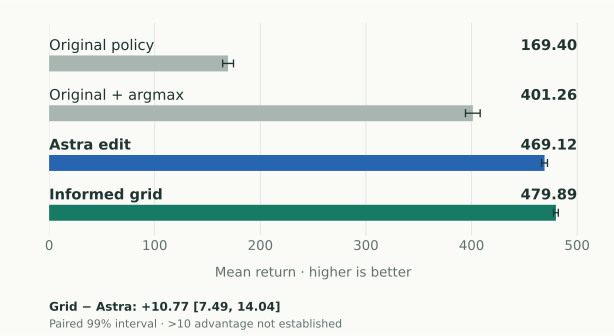
Figure 1. The improvement survives, but its interpretation changes. Four main comparisons on 1,024 fresh shared seeds. Bars show mean return; whiskers are descriptive 95% bootstrap intervals. The paired grid-minus-Astra difference is annotated separately. The exploratory edited-plus-argmax policy scored 487.80, the highest observed mean, but is outside these four bars and the prespecified superiority comparisons. All seven policies and their episode scores.
Simply choosing the original policy’s highest-probability action—argmax—raised its mean to 401.26. Angle scaling alone reached 402.73, while output scaling alone reached 256.30. The combined Astra edit still did better, at 469.12. Those ablations support contributions from both parts of the edit. The seventh policy, the Astra edit with argmax actions, scored 487.80 descriptively; it was outside the prespecified superiority comparisons.
Then the numerical control changed the story. An eight-point grid, informed by the earlier successful edit, selected angle gain 12 and output gain 6. Its mean was 479.89. The grid’s advantage over the Astra candidate was 10.77, with a paired two-sided 99% interval of [7.49, 14.04] (per comparison; five comparisons have a Bonferroni family-error bound of 0.05). The direction favors the grid; an advantage larger than the prespecified 10-return margin is not established.
This was not an independent contest to discover the right edit from scratch. The grid inherited a useful parameterization and range from the earlier result. Both searches tried eight candidates on 128 episodes each, with the same maximum candidate-step budget, but their actual work differed: 308,555 versus 362,308 simulator steps. The comparison supports the resulting numerical policy, while leaving the value of Astra’s diagnosis unresolved.
There was another useful control. An equivalent inference wrapper and the edited weights produced the same sampled actions at 1,485 visited parity states, with small floating-point logit differences. The weight edit packages the intervention into a checkpoint; it does not add a function unavailable to that wrapper.
The lesson is specific: the edit improved this policy substantially, but improvement over the original did not establish an advantage for LLM optimization over an informed numerical alternative.
Why some targeted edits work
The clearest success came from a problem that needed very little structural change: an image classifier was too confident.
The public ResNet18 classifier kept choosing the same classes after we divided its final-layer weights and bias by a positive temperature. Mathematically, logits change from z to z/T. Their ranking stays the same, but the probability distribution becomes less concentrated when T is greater than one. This is established temperature scaling. [3]
A 301-point grid selected T = 1.82938 using development data. On 1,000 reserved CIFAR-10.1 images, accuracy remained 89.9%, while mean confidence fell from 96.09% to 89.77%. Negative log-likelihood—a score that penalizes confident mistakes—fell from 0.423800 to 0.332648, a 21.5% reduction. The NLL-improvement lower bound was 0.052818, above the required 0.01. [1]
CIFAR-10.1 supplies naturally collected images for testing generalization beyond the original CIFAR-10 test set; the measured overconfidence of this particular checkpoint comes from our experiment. [4] The successful intervention adjusted confidence without needing to learn a new class distinction. It improved probability quality, not recognition accuracy. It also serves as a conventional numerical positive control, rather than evidence for a uniquely LLM-discovered repair.
The continuous MountainCar policy had a different opportunity. It already reached the goal reliably, but reaching the goal consumed control effort. For a successful episode, reward is 100 minus the accumulated quadratic action cost.
Astra inspected trajectories and motivated two adjustable quantities: motor-mean gain and normalized-velocity gain. A frozen 16-point numerical search chose 0.74178 and 1.45283. On 1,024 fresh seeds, both the original and edited policies completed every episode. The edited mean return rose from 93.9295 to 96.2973, so its +2.36785 gain directly corresponds to lower control cost on those episodes. Average completion time also fell slightly, from 299.88 to 295.15 steps. [1]
What Astra actually contributed. The archived pre-search plan makes the division of work concrete:
- Information available: canonical dynamics and reward, original state/action trajectories, and a separate 24-seed pilot. Motor gain 0.8 increased return by about 0.93 but increased mean steps by 27.5%; velocity gain 1.2 shortened episodes by 9.0% with almost unchanged return.
- Contemporaneous hypothesis: “Joint lower torque and increased velocity sensitivity may improve energy efficiency without excessive slowdown.” This is a recorded hypothesis, not a neural mechanism inferred from the final success.
- Intervention: Astra motivated the two controls; the frozen numerical search selected their values. The selected proposal replaces
action_net.weightandaction_net.biaswith their originals multiplied by 0.74178, and scales column 1 ofmlp_extractor.policy_net.0.weightby 1.45283. - What evaluation revealed: the selected candidate completed every fresh episode with lower control cost. That supports the intervention’s practical effect; it does not prove the pilot’s proposed explanation of the internal computation.
The archive preserves this diagnosis and specification, but not the complete prompt or a transcript of every tensor inspection. The exact gains came from numerical selection, not an LLM-written prediction of the optimum.
The candidate beat a fixed output-gain 0.8 control by 1.49825 return, with a one-sided 99% lower bound of 1.18368. It also passed the completion-time and introduced-failure requirements. This establishes an efficiency improvement. A separately optimized one-dimensional gain search was not tested, and the edit has an equivalent input/output wrapper.
These two examples explain what a useful targeted edit can look like: adjust an existing behavior through a control whose effect is understandable. One changes confidence; the other changes control cost while retaining completion. CartPole’s ablations support a similar account involving sensitivity and action selection.
Table 1. Accepted outcomes on reserved data. Discrete MountainCar is a separately registered retest; we return to its original failure below. Source: experiment records. [1]
| Case | Reserved evaluation | Original → edited | Decision |
|---|---|---|---|
| ResNet18 on CIFAR-10.1 | 1,000 images | NLL 0.423800 → 0.332648; accuracy 89.9% → 89.9% | All three gates pass |
| CartPole | 256 episodes | Mean return 164.60 → 465.14 | All six gates pass |
| Discrete MountainCar retest | 1,024 episodes per start group | Target return −119.43 → −110.49; preservation −108.31 → −107.15 | Both gates pass |
| Continuous MountainCar | 1,024 default-reset seeds | Mean return 93.9295 → 96.2973; both policies succeed 1,024/1,024 times | Native and stronger external gates pass |
Tables scroll horizontally on small screens. Figures have a separate mobile layout and open at full size when selected.
Recovering one skill can cost another
A useful control knob is not always available. For a language model, the behavior we want to recover may be mixed with adaptations we want to keep.
We compared SmolLM2-360M-Instruct with its public base checkpoint. The target was science-question accuracy; the behavior to preserve was structural instruction compliance. Blending toward the base reverses a fraction of the fine-tuning update. Earlier work on model soups and task arithmetic shows that combining parameters can be useful under particular designs. Our repair search tests its own model pair and objectives. [5] [6]
Astra tried six selective tensor masks, then five uniform blend strengths from 15% to 35%, and finally six layer-wise schedules. The final selected schedule moved successive eight-layer blocks 30%, 20%, 10%, and 0% toward the base, with 15% for nonlayer tensors. It passed development on 2,560 ARC questions and 768 instruction prompts. Earlier exposed holdouts had been explicitly moved into development; the final evaluation used new examples.
Science accuracy here uses zero-shot continuation scoring under a shared tokenizer/chat interface. A lower score establishes a regression under that evaluation; it does not independently establish lost scientific knowledge.
On that fresh evaluation, full rollback answered the most science questions correctly—and followed the fewest instructions. The selected layer blend offered a less costly compromise. [1]
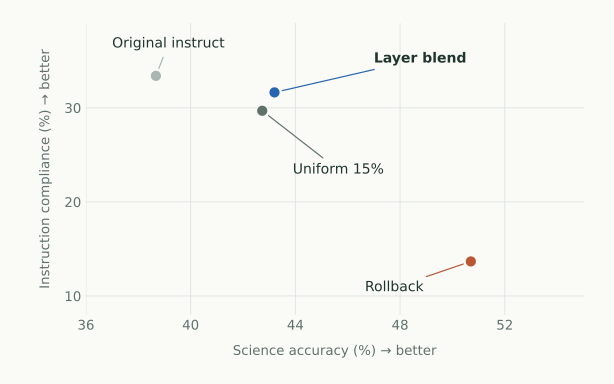
Figure 2. Higher and farther right is better. Moving toward rollback improves science accuracy while sacrificing instruction compliance. Each point uses the same fresh holdout: 1,280 questions and 512 prompts. These are point estimates; preservation was not established for any edit under the frozen gates. Source: final SmolLM2 comparison. [1]
Table 2. The counts behind the tradeoff. ARC uses 1,280 questions; instruction compliance uses 512 prompts. Source: final SmolLM2 comparison. [1]
| Checkpoint | ARC correct | Instruction passes | Both fixed gates pass? |
|---|---|---|---|
| Original instruct | 495 / 1,280 (38.67%) | 171 / 512 (33.40%) | Reference |
| Selected layer blend | 553 / 1,280 (43.20%) | 162 / 512 (31.64%) | No |
| Uniform 15% blend | 547 / 1,280 (42.73%) | 152 / 512 (29.69%) | No |
| Full rollback | 649 / 1,280 (50.70%) | 70 / 512 (13.67%) | No |
The layer blend answered six more ARC questions and passed ten more instruction prompts than the uniform 15% blend. These are descriptive advantages; superiority over that control was not established. Against the original instruct checkpoint, the layer blend gained 4.53 percentage points on ARC and lost 1.76 points on instruction compliance.
This pattern is consistent with a simple explanation: reversing part of a fine-tuning update can reverse useful adaptation along with the behavior associated with the regression. It does not prove that the two capabilities occupy inseparable circuits. Six layer schedules are a narrow search through possible interventions.
LunarLander supplied a more direct example of damage elsewhere. A vertical-velocity sensitivity edit improved its target cohort by 13.43 return, while right/down starts lost 16.66 return and 9.38 percentage points of success. The candidate was rejected on development data. Shared input sensitivity and nonlinear rollout dynamics are plausible explanations; the experiment establishes the subgroup tradeoff, not a circuit-level mechanism. [1]
These cases show why a target score cannot carry the whole argument. The intervention changes a shared model, and the benefit may not be shared by every task or starting condition.
A failed test does not always mean a harmful edit
The SmolLM2 result contains a subtlety. Its observed instruction loss was smaller than the five-point tolerance, but its uncertainty extended just beyond it.
AutoWeight’s preservation gate required the lower confidence bound on the instruction-score change to be at least −5 percentage points. The selected blend’s bound was approximately −5.005 percentage points. It therefore failed confirmation, and no repair checkpoint was accepted. The frozen procedure was not rerun to seek a pass. [1]
The five-point tolerance was an experimental acceptance margin, not a validated deployment standard. Relative to the original 33.40% instruction pass rate, it permits a loss of about 15% of that rate. Whether that loss is acceptable depends on the application; passing this gate would not by itself establish deployment suitability.
That approximately 0.005-point shortfall is a decision under a finite-bootstrap rule, not a sharp scientific boundary between a harmless and harmful edit. The requirement was not established with the available evidence.
Discrete MountainCar makes the distinction easier to see. Its candidate multiplied 64 velocity-input weights by 0.95. On the first reserved test, target improvement passed. The preservation group’s average return was slightly better too: +0.055. But its lower bound, −2.424, missed the permitted −2 margin.
A separately registered retest kept the identical candidate bytes and thresholds and used 1,024 fresh episodes per group, instead of 128. Its preservation mean was +1.160, with a lower bound of +0.333. Both gates passed. [1]
The original failure remains part of the record. The larger test provides stronger evidence, but both sample precision and the observed mean changed. It does not tell us that every rejected edit would pass with more data.
It does tell us to distinguish observed damage from failure to establish preservation. LunarLander illustrates the first. MountainCar illustrates why the second can occur even when the point estimate is positive. Calling both simply “weight editing failed” would discard the most useful information.
Conclusion and our perspective
Yes, weight-space programming can improve an existing model on held-out tests. These experiments do not establish that an LLM is a better optimizer than a well-informed numerical method. The gains are real; the controls determine what we can claim about how they were found.
Our interpretation is that the clearest opportunity is finding a useful, testable control within an existing model. Temperature scaling has a mathematical explanation: it changes confidence without changing class order. Policy gains change input sensitivity and action selection. In continuous MountainCar, the reward gain directly means lower control cost while completing every tested episode. These are functional explanations and measured outcomes, not evidence that an edit created a missing capability.
The negative results require separate explanations. SmolLM2 recovered science scores while losing instruction compliance; LunarLander helped one starting cohort while harming another. Other candidates failed to establish the required gain or preservation margin. The unchanged MountainCar candidate’s later success shows why rejection is not automatically proof of harm. None of these results identifies an inevitable neural mechanism behind failure.
We currently see the LLM’s most promising role as proposing interventions and experiments. Astra suggested useful edits and parameterizations; numerical search sometimes selected the strengths. The informed CartPole grid then scored higher than the earlier Astra candidate. Because it inherited the earlier insight, that comparison leaves the independent value of Astra’s diagnosis unresolved. Testing discovery advantage would require matched information and budgets from the start.
For AutoWeight, the strongest demonstrated value is making a proposed repair earn acceptance through development selection, fresh confirmation, explicit preservation metrics, and credible controls. That is our interpretation of these heterogeneous cases, not a general ranking of optimizers.
We started with a strikingly better CartPole score. We end with a more useful distinction: a better checkpoint is one result; evidence of a better repair method is another. The successes justify trying targeted edits. The failures and stronger baselines show what must be checked before trusting them.
Methods and remaining results
AutoWeight freezes a checkpoint, development examples, reserved confirmation examples, and acceptance requirements. Proposals are scored on development data; a selected eligible candidate can then spend its confirmation test. Vision and policies use custom evaluators that load named arrays; SmolLM2 uses native Hugging Face checkpoints. The target models were not retrained during these edit searches. [10]
The collection covers one image-classification case, eight RL environments, and four language-model cases, represented by 14 external runs/cohorts and three related SmolLM2 studies. No fault was injected into these public checkpoints. Most RL cases are performance shortfalls, rather than documented historical regressions. Follow-ups are related experiments, and cases have different objectives and budgets; a pooled success rate would be misleading. All reported measurements are from the archived experiments. [1]
Acceptance rules
Table 3. Complete acceptance rules for the main experiments. Changes are candidate minus original unless noted; pp means percentage points. Every requirement in a row must pass. Lower-is-better NLL and Brier are oriented so improvement is positive. These margins were frozen experimental choices, not deployment standards. Protocol and report records.
| Experiment | Target and minimum improvement | Preservation metric and permitted loss | Uncertainty rule |
|---|---|---|---|
| ResNet18 calibration | NLL decrease ≥ 0.01 | Accuracy: 0 pp loss; Brier increase ≤ 0.005 | Native paired bootstrap; 3 gates |
| CartPole initial confirmation | Separately for left/right initial tilt: return gain ≥ 30, fraction reaching ≥475 steps gain ≥ 8 pp | Fraction surviving ≥200 steps: loss ≤ 3 pp, separately for each tilt group | Native paired bootstrap; 6 gates |
| Discrete MountainCar, original and retest | Central starts [−0.50, −0.45): return gain ≥ 5 | Other standard starts: return loss ≤ 2 | Native paired bootstrap; 2 gates within each test; no joint error guarantee across the retest |
| Continuous MountainCar, native | Return gain ≥ 0.5 | Success fraction: 0 pp loss | Native paired bootstrap; 2 gates |
| Continuous MountainCar, additional external rules | Return gain ≥ 0.5 over original and ≥ 0.1 over fixed output gain 0.8 | Upper bound on mean(candidate steps − 1.25 × original steps) ≤ 0; zero introduced failures and exact upper failure-probability bound <0.005 | 50,000 paired draws, one-sided 99% bounds for return/time; exact one-sided 99% Clopper–Pearson failure bound; four-rule union bound ≤ 0.04 |
| SmolLM2 selected layer blend | ARC accuracy gain ≥ 2 pp | Strict instruction pass-rate loss ≤ 5 pp | Native paired bootstrap; 2 primary gates |
For the native rule, resample paired cases 4,096 times using seed 7612301 and compare each gate’s lower bound at quantile 0.05 / number of gates with its stated threshold. The family-error target is 0.05 within that test; bootstrap coverage is approximate. The exact SmolLM2 preservation lower bound was −5.0048828125 pp, below the −5 pp requirement. Its ARC lower bound was +3.046875 pp, above +2 pp.
The separate CartPole control study tests superiority rather than acceptance of a new repair. Its frozen rule required the Astra-minus-comparator one-sided 99% lower bound to exceed 10 return for each of five contrasts (50,000 paired draws; Bonferroni family-error target 0.05). The two-sided intervals reported here are 99% per comparison, with a family-error bound of 0.05 across five intervals—not 99% joint coverage. The edited-plus-argmax control is descriptive only.
Table 4. Rejected outcomes across the collection. Development failures left their reserved confirmation sets unused. A positive mean alone does not satisfy a confidence-bound requirement. [1]
| Case and stage | Observed evidence | What failed |
|---|---|---|
| Pendulum · development | Eight candidates rejected; best target mean gain +2.91, lower bound −0.06, required +5 | Target improvement not established |
| Acrobot · development | Twelve candidates rejected; best target mean gain +0.57, lower bound −1.87, required +3 | No eligible candidate in the bounded search |
| BipedalWalker · development | A candidate gains +13.90 reward; improvement in the fraction of episodes scoring ≥300 has lower bound +6.25 pp, required +10 pp | Reward alone does not satisfy the joint objective |
| LunarLander · development | Velocity scaling gains +13.43 target return but loses 16.66 return and 9.38 pp success on right/down starts | Observed subgroup damage |
| LunarLanderContinuous · development | Selected candidate gains +15.09 return; lower bound +3.94, required +5 | Required target margin not established |
| Discrete MountainCar · original confirmation | Preservation mean +0.055; lower bound −2.424, required −2 | Preservation not established |
| SmolLM2 layer blend · fresh confirmation | ARC +4.53 pp; instruction −1.76 pp; instruction lower bound −5.0049 pp, required −5 pp | Preservation narrowly fails |
Table 5. Exploratory language-model pilots. These metrics are narrower than the public failure reports that motivated them. None produced an accepted repair. [1]
| Pilot | Recorded development outcome | Interpretive limit |
|---|---|---|
| Qwen2-0.5B biology | Best first-token Yes/No accuracy 62.5%, below an 80% floor; four of six allowed attempts recorded | Incomplete search; short authored judgments do not measure full explanations |
| Qwen3-0.6B chronology | Four attempts; best 56.25%, unchanged from baseline | The original always answers True, so 56.25% is also the majority-label baseline |
| SmolLM-135M science/sentiment | Six attempts, including one unscored incompatible-donor error; best science accuracy 29.69%, below a 50% floor | First-token scoring is sensitive to answer format; no confirmation |
Selection and retesting. The first two SmolLM2 rounds had no eligible candidate; their held-out comparisons were diagnostic. The layer round selected one development-eligible candidate before fresh scoring. Exposed examples became development data in later rounds. The MountainCar retest was separately registered after failure, with no new weight search. There is no joint error guarantee across this collection of searches and retests.
Uncertainty. Native gates generally used 4,096 paired bootstrap draws, a 0.05 family level, and per-run metric correction. SmolLM2’s primary decision used two gates; secondary simultaneous control analyses are separate. CartPole’s five prespecified contrasts used 50,000 draws; the reported two-sided intervals are 99% per comparison, with a Bonferroni family-error bound of 0.05. Continuous MountainCar added stronger external one-sided 99% bounds and an exact introduced-failure bound. Bootstrap coverage is approximate. Figures use archived statistics, with no new inference or resampling.
Language data and scoring. ARC is a science-question benchmark. [7] The final holdout uses unused questions from its official train splits, because earlier rounds nearly exhausted the Challenge test split. They were held out from repair selection, not guaranteed absent from upstream training. Instruction scoring uses verifiable constraints from the IFEval approach, [8] applied to 512 unused Ai2 prompts with the same 17 supported Google strict checkers. These are not the original IFEval prompt set. [9] Source mixtures differ across rounds, so absolute scores are not one learning curve.
ARC uses zero-shot continuation ranking; the instruction metric measures structural compliance, not general answer quality. Rollback uses the common instruct tokenizer/chat interface. One legacy development checker had a seeded random-letter fallback; a separate exclusion sensitivity did not change selection. No fresh-holdout checker consumed random state. Infrastructure errors, such as incompatible donor tokenizers, are separate from scored model failures.
Scope and software. RL conclusions apply to the recorded simulator versions and reset distributions. External vision/RL runs used released AutoWeight 0.5.0; later SmolLM2 runs included the documented native-HF extension. The integration checked 172 content-hashed records, frozen dataset/evaluator identities, and five accepted export hashes representing four case families. This was an artifact-consistency audit, not an independent rerun of all models.
Experiment records and provenance
The public evidence appendix contains 41 browsable records: protocols, checkpoint revisions, exact selected edit specifications, acceptance reports, evaluation identifiers, and individual outcomes for the central CartPole, SmolLM2, and continuous-MountainCar comparisons. A manifest identifies each archived source and the hash of its published copy. Local absolute paths are redacted where needed; those copies are explicitly labeled.
This is a partial evidence release. Calibration and discrete MountainCar have protocols and aggregate reports; their individual observations are not included. Other exploratory runs, checkpoint binaries, and complete agent conversations remain unpublished. The records support inspection of the reported experiments, not a claim of independent replication or a complete inference reproduction package. The GitHub reference identifies the software separately and still requires repository access.
References
-
Xavier, M. (2026). AutoWeight experiment records: protocols and outcomes. Selected archived protocols, edit specifications, reports, and per-case scores, 7 November 2026. Author-reported evidence; release scope and redactions are documented in the appendix.
-
Takehi, R., Teoh, J., Zhang, A., and Khattab, O. (2026). Sparks of Weight-Space Programming: LLMs can natively read & write neural network weights. Research blog, 2 November 2026.
-
Guo, C., Pleiss, G., Sun, Y., and Weinberger, K. Q. (2017). On Calibration of Modern Neural Networks. ICML 2017.
-
Recht, B., Roelofs, R., Schmidt, L., and Shankar, V. (2019). Do ImageNet Classifiers Generalize to ImageNet?. ICML 2019, PMLR 97, 5389–5400. Introduces new test sets for both CIFAR-10 and ImageNet.
-
Wortsman, M., et al. (2022). Model soups: averaging weights of multiple fine-tuned models improves accuracy without increasing inference time. ICML 2022.
-
Ilharco, G., et al. (2023). Editing Models with Task Arithmetic. ICLR 2023.
-
Clark, P., et al. (2018). Think you have Solved Question Answering? Try ARC, the AI2 Reasoning Challenge. arXiv:1803.05457.
-
Zhou, J., et al. (2023). Instruction-Following Evaluation for Large Language Models. arXiv:2311.07911.
-
Allen Institute for AI. IF_multi_constraints_upto5. Dataset; evaluated revision
2e3a77407b7fce69f95b248d64a884e3ae1c2423. Source of the fresh instruction prompts, used with the supported strict checkers. -
Xavier, M. (2026). AutoWeight. Software for proposing, evaluating, and confirming model-weight edits. GitHub repository; repository access required.